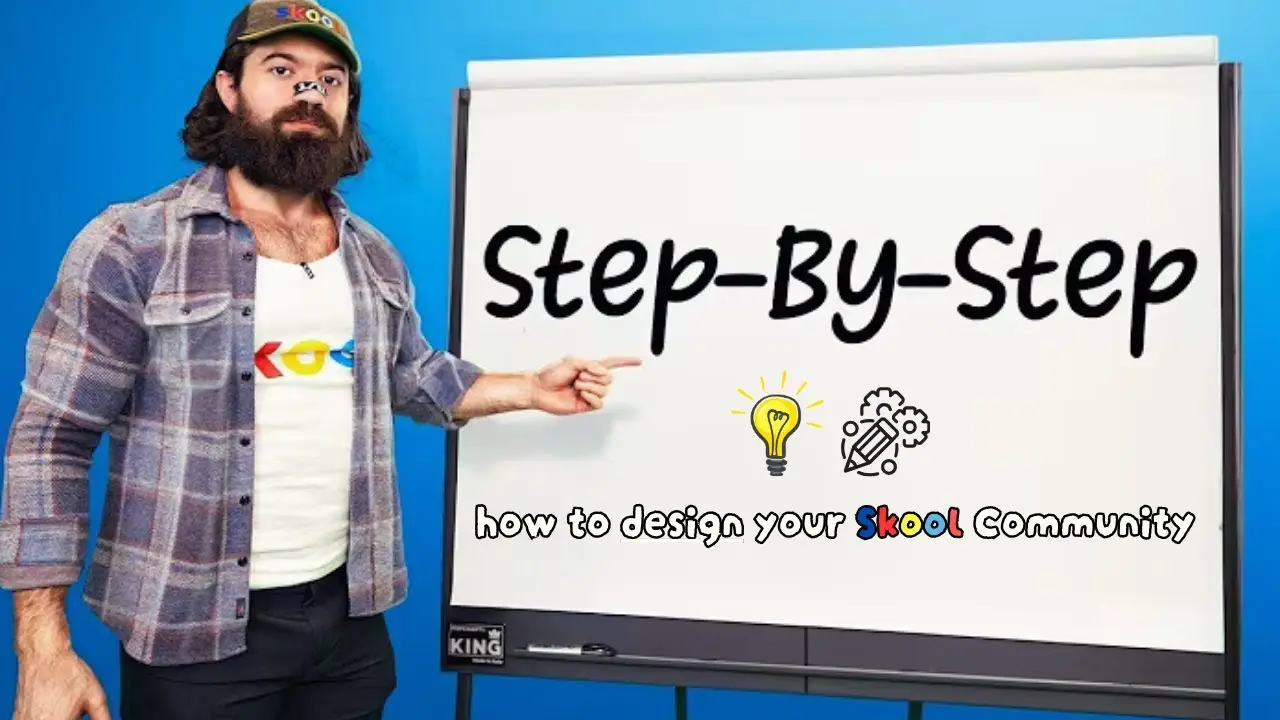
How to Build a Profitable Online Community (Step-by-Step)
In my video, I walk you through the exact framework for designing a profitable online business using a community model. This isn’t theory—it’s the step-by-step process that’s helped thousands of creators build sustainable recurring revenue by solving problems they’re passionate about.
Whether you’re an expert or complete beginner, this approach works because it leverages what you already know and care about.
I break down everything from choosing your audience to deciding what goes inside your community in this detailed tutorial.
Who Is Your Community For?
The first question I address in my video is who your business is for, and this is where most people overcomplicate things. The answer is simpler than you think: you want people who share the same interest, goal, or problem as you. Whether it’s learning to day trade, flip houses, paint watercolors, or play ping pong, the key is finding others who want to solve the same challenge you’re facing.
I call this approach “scratching your own itch.” Some of the most successful businesses in history were started by entrepreneurs who suffered with a problem for a long time and decided to find the solution. The beautiful part is that you don’t have to be the expert from day one. If you already know how to fix cars, paint, or trade stocks, great—you can lead as the expert. But I explain that most of you will probably choose the crowdsourcing route instead.
The Expert Path vs. The Crowdsourced Path
In my video, I outline two distinct paths you can take. The expert path is straightforward: you already have the knowledge and you’re sharing it directly with your community. But the crowdsourced approach is where things get really interesting. This model involves finding other people who are simply interested in solving the same problem as you, then using your community to help solve problems together.
Community members can go out, find answers, bring them back, and provide value to everyone else. But here’s the skeleton key I share: when you put together a group of 100, 500, or even 5,000 people, you can reach out to high-status individuals who would normally ignore you. You can offer them distribution and access to your audience in exchange for a 30-minute video or Q&A session with your community.
This creates a win-win situation. You get valuable content from someone way above your current level, they get exposure to a targeted audience, and your community perceives you as delivering massive value. The platform Skool has been specifically built to facilitate this crowdsourced model, removing any excuse for not getting started.
Should You Start Free or Paid?
The next decision I cover is whether to make your community free or paid. My recommendation for beginners is clear: start for free, get people in, learn what they like, and provide value. You’ll learn how to run a community without the pressure of delivering paid results immediately. Once you feel confident that you can provide value and that your audience is valuable, you can flip it to paid at any point.
I emphasize in my video that this isn’t an irreversible decision. You can start free and move to paid when you’re ready. If you’re already confident in your ability to deliver value, you can start paid right from the beginning. The key insight here is that building an audience is your most valuable asset, and whether it takes two months or six months to monetize doesn’t matter in the long run.
I compare this to how clubs operate: early in the night, they let people in for free to build momentum, then once the party is rolling, they start charging cover. Your community works the same way. Starting with a thousand engaged free members and then switching to paid gives you incredible momentum compared to launching a paid community to an empty room.
What Goes Inside Your Community?
In my video, I break down the three big buckets of value you can provide: access, content, and events. Access means giving members time with you or connecting them to people they couldn’t reach on their own. Your time becomes surprisingly scarce when you have 100 people all wanting it, making access valuable in itself.
For content, this is about creating exclusive material that isn’t available publicly. It could be videos, guides, frameworks—anything that helps solve the shared problem. The third bucket is events, which can be digital or in-person, large conferences or small group hikes. I explain that you should create a schedule or cadence around providing these elements so members know what to expect.
For example, if you’re running a car mechanics community, you might do a monthly Q&A call with a master mechanic. Your 2,000 members give you the collective asking power that individual members don’t have. A renowned mechanic who specializes in historic cars might ignore a single person’s request but would likely say yes to reaching 2,000 enthusiasts at once.
The Value Equation Framework
I reference my book “$100 Million Offers” in my video when explaining what actually makes a community valuable. The value equation has four components, and assuming you’ve aligned on the outcome (the problem you’re solving), the other three variables determine your community’s value: reducing risk, increasing speed, and decreasing effort and sacrifice.
Every piece of content, access opportunity, or event you create should address at least one of these factors. If you can show mechanics how to not blow up their car, you’re reducing risk. If you can show them how to complete a restoration in three months instead of a year, you’re increasing speed. If you can teach them techniques that don’t require them to stop doing things they love or start doing things they hate, you’re decreasing effort and sacrifice.
I emphasize keeping these principles in mind whenever you’re planning what to deliver to your community. Two simple ways to figure out what would be valuable: ask yourself what would be epic if you were in their shoes, or simply ask your community directly what they’d find cool. Don’t underestimate the doors that can open when you’re asking on behalf of an entire community rather than just yourself.
The School Games Advantage
In my video, I discuss how the Skool Games was designed to remove every obstacle that traditionally stops people from starting an online business. This is why Skool has such a high success rate—we’ve obsessed over removing barriers to success. Of the five out of seven communities who won the Skool Games in their first month, only two had organic followings before they started.
You don’t need fancy software, separate calendar tools, or complex payment processing. Everything you need is built into Skool. You don’t even need to know what your community will be about yet—I show you how to pick it in less than 20 minutes. For getting members, you don’t have to ask people you know; you can crowdsource your community through Skool itself from the millions of users already on the platform.
As for technical skills, I make it clear: if you can watch my video, you have all the technology you need to start, scale, and succeed. One out of two people who start a paid community on Skool make money, with the average paid community owner earning $1,360 per month. Some, like Kyle who I mention, never won any awards but built a community generating $4,000-$5,000 per month in recurring revenue.
Getting Started Right Now
In my video, I explain exactly what happens when you sign up. You’ll follow a proven process to build a paid community about whatever you love. If you become one of the top 10 communities on the leaderboard, you’ll join me and other successful community owners in Vegas. Even if you don’t win the first month, you keep competing every month until you do win, and then you can access additional resources with all the past winners and alumni.
The worst-case scenario is that you try it, decide it’s not for you, and walk away with thousands of dollars worth of knowledge for your next business venture. The best-case scenario is that you take a zero-risk move and change your life forever. I offer an unconditional money-back guarantee—if you finish your trial and forget to cancel, just let us know and we’ll refund you. We simply want people to win.
The only guarantee, as I state at the end of my video, is that if you don’t take the shot, you’ll stay exactly where you are. But if you do take action, you could be the next person celebrating how quickly you built an online business with consistent monthly recurring revenue. I personally onboard new members live, and if you join this month, you can ask me whatever you want on our onboarding call. This isn’t a get-rich-quick scheme—it’s a real way to build a sustainable, profitable business around your expertise with the right system and support.