Skool Community Not Converting? 6 Daily Steps to Get Clients
If you’ve launched a community on Skool but it’s not converting members into clients, you’re likely using it as a vault instead of a funnel. In my video, I share the exact six-step daily system we use to build authority, grow engagement, and systematically convert community members into paying clients without relying on cold outreach or paid ads.
This is the same method we teach inside our paid program, Membership Launch Accelerator, and I’m giving it away completely free so you can start implementing it today.
In this video, I pull back the curtain on our Daily Member Method and show you how to transform your community into a client-generating machine.
Stop Using Your Community as a Vault
In my experience, most coaches make a critical mistake when building their online presence. They pour energy into creating content on social media, building funnels, and designing courses, but they treat their Skool community as nothing more than a vault to house their program behind a paywall. This approach fundamentally misses the opportunity that community platforms offer.
Right now, the online business world is buzzing about Skool and how it can replace platforms like Kajabi, ClickFunnels, or GoHighLevel. But simply migrating your course content to a new platform won’t magically explode your business. If you continue hiding your knowledge behind a paywall, your ideal clients won’t find you, and the ones who do join won’t experience the transformation that comes from genuine community engagement.
Leverage Community as a Stage, Not a Storage Unit
I explain in my video how we need to shift our thinking from vault to stage. Your community should be a place where you showcase your expertise, build authority, and create a tribe of raving fans. When done correctly, it doesn’t just rely on you being the engine driving everything forward—it actually positions you as the authority while continuously attracting the right people to your business.
This distinction becomes even more critical as AI makes information increasingly accessible. What your clients really need isn’t more information locked behind a paywall. They need accountability and support from someone they know, like, and trust. That’s exactly what a properly structured community provides.
When you use Skool as a system that showcases your knowledge, indoctrinates people into your process, and clearly guides them toward working with you, you create a funnel that moves prospects from visibility to engagement to conversion. This machine starts doing the heavy lifting for you instead of requiring you to constantly push buttons and manually drive every aspect of your marketing.
The Three-Part Foundation Before the Daily Method
Before diving into the six daily steps, I want to share the three foundational elements that make this entire system work. These aren’t daily tasks but rather strategic positioning decisions you need to make once and refine over time.
Build Visibility in Aligned Communities
The first foundation is building visibility in aligned Skool communities where your ideal clients already hang out. I use the analogy of parties happening all over the world. You don’t want to throw your own party and wonder why nobody shows up. Instead, you want to go to parties that are already thriving, filled with people who share common interests with you and who would benefit from your help.
What makes Skool particularly powerful is the leaderboard system. When you consistently show up in other communities, add value, and demonstrate your expertise, you quickly rank on those leaderboards and become known as the person who’s always there, who cares, and who has real knowledge to share.
Position Yourself with Clear Messaging
The second foundation is crystal-clear messaging, which is especially challenging for coaches who’ve built successful in-person businesses but haven’t had to market themselves online before. The formula I teach is simple: articulate the one problem you solve for one person through one pathway.
This one-problem-one-person-one-pathway framework helps you position your community in a way that attracts the right people and repels the wrong ones. Without this clarity, your community becomes a confusing mix of messages that fails to magnetize your ideal clients.
Repurpose Content with Intention
The third foundation is repurposing content strategically. Content equals credibility and connection with your audience. When you post valuable content in other communities and even better content in your own, you create reasons for people to come and reasons for them to stay. This isn’t about copying and pasting the same post everywhere—it’s about intentionally adapting your message for different audiences and contexts.
The Six-Step Daily Member Method
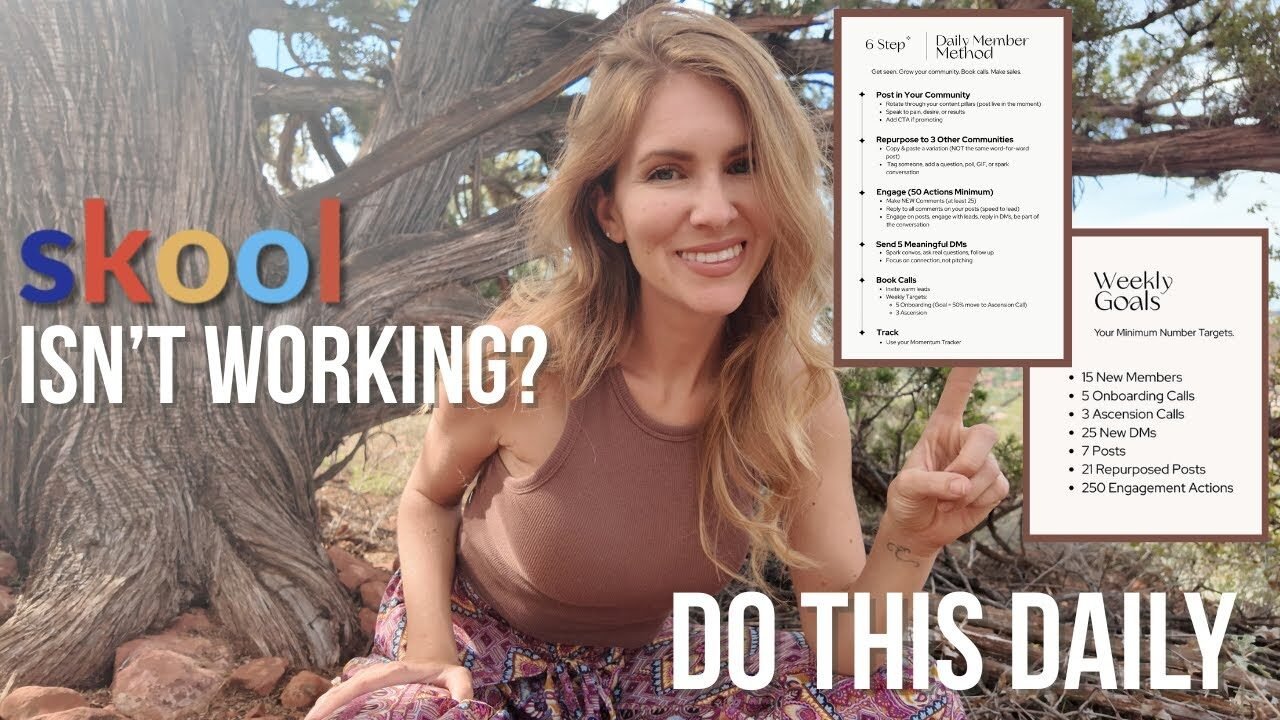
Now let me walk you through the actual daily system. I created a printable version of this method because I heard from so many clients that they’d sit down at their desk unsure of what workflow would actually move the needle. This checklist ensures that every day you’re making progress on the tasks that genuinely grow your business.
For context, our Skool community is currently ranked in the top 50 overall of all communities on the platform, top 13 in the business category, and top 13 in the money category—which I consider the most challenging category to rank in. We’ve achieved this through consistent application of this method combined with a highly engaged community that supports one another.
Step 1: Post in Your Community
The first daily action is posting in your own community. I strongly recommend posting live in the moment when you have a breakthrough, an aha moment, or something that inspires you. There’s nothing that says “community” more than bringing your members into an experience with you and helping them discover that same aha moment.
My partner Steve excels at this—he’s constantly posting in the moment while we’re working through things together. Your posts should speak to the pain, desire, or results your ideal clients care about. Share inspiration and build that sense of community by helping people get to know each other.
Every post should include a call to action, even if you’re not actively promoting something. A call to action facilitates conversation and boosts member engagement. Think of it like a party—a conversation requires back-and-forth, not just you talking at people. A call to action invites the other person to open up and share about themselves, which is what people really want to do.
Step 2: Repurpose to Three Other Communities
The second step is repurposing that post to three other communities. But here’s the critical distinction I make in my video: do not copy and paste the exact same post everywhere. Use your original post as a baseline, then reformulate it for an audience that doesn’t know you as well, or pull out a different lesson from the same story.
Why does this matter? Because there will be overlap between communities. The strategy you’re implementing in other communities is designed to bring people back to yours, which means some people will see both posts. If they’re identical, you’ll wear out your audience. Instead, add pizzazz—tag someone you thought of, ask a different question, add a poll or GIF to spark genuine conversation.
Step 3: Engage with 50 Actions Daily
The third step is engagement—a minimum of 50 actions every single day. This includes making new comments where you’re cheerleading and adding value, replying to all comments on your posts, engaging on other people’s posts, engaging with leads, and replying in DMs. You must be an active part of the conversation.
I emphasize speed to lead here. We do not “post and ghost” because that would be as rude as starting a conversation at a party and then walking away when people respond. If you fail to reply to comments on your posts, people will stop engaging, and then you’ll wonder why your community feels dead. The engagement creates the sense of community that makes everything else work.
Step 4: Send Five Meaningful DMs
Step four is sending five meaningful direct messages focused on sparking conversations and asking real questions. This might include following up with someone you spoke with last week whose conversation went quiet because life got busy. The key principle here is focus on connection, not pitching.
If you’ve set up your Skool community properly and you’re actively engaging in other communities, people will naturally come back to yours. They’ll see what you do, recognize you as the authority and expert in your niche, and they’ll ask you questions about what you help with. When the system works correctly, it magnetizes people to you based on your expertise, which means you don’t need to be sleazy or salesy.
Step 5: Book Calls
The fifth step is booking calls. While back-and-forth DM conversations have value, I truly believe the best way to help someone is getting them on a call. On a call, you can hold space and get them into the flow of conversation to go deeper than text allows. When someone’s messaging you, you don’t know what’s happening in their world—their boss might walk in, their kids might need attention, or countless other distractions might interrupt the momentum.
On a face-to-face Zoom or phone call, you have their undivided attention to really go deep. There’s a reason coaching sessions aren’t held only in DMs—real transformation happens during dedicated time with your client. The system I teach involves booking five onboarding calls per week, with the goal of converting three of those into full 60-minute ascension sales calls.
Step 6: Track Your Numbers
The sixth and final step is tracking your numbers using a momentum tracker. This is critically important because it reveals where you have the biggest gaps in your system and where your business isn’t working right now. When you know what’s not working, you can focus your attention on the areas that will generate the results you want.
Why Showing Up Outside Your Community Matters
All six of these daily steps work together to build your machine—your Skool community functioning not as a program behind a paywall but as a funnel system that adds value, builds connection, and runs like a well-oiled machine. Your authority builds through visibility and repetition.
Posting across Skool communities builds recognition, familiarity, and trust. Eventually people start wondering about you and automatically visit your profile. They see what communities you run, they might follow you on social media, but most importantly, they’re enticed to join your community if they have the problem you solve. This is where your messaging must be spot-on.
This is where your funnel system kicks in and turns that member into a client if they have their hand raised looking for a solution—which is you and your paid program. That’s why it needs to be mapped out very clearly: what your offer is, what your price is, and what transformation you provide.
The Skool algorithm rewards consistency and value. It does not reward spam. This entire system is based on adding value, having real human connection, and being the life of the party. When you implement these six steps daily, you create a sustainable system for growth that doesn’t depend on cold DMs, paid ads, or constantly chasing new leads.
Getting Started with the Daily Member Method
I’ve made the printable version of this six-step method available for free. You can grab it by joining our free community where we also share bonus trainings on Skool funnels, community strategy, and offer design. We also host monthly masterclasses where I break down the exact systems I use for myself and my clients to help them scale and sell premium offers that stand out in a competitive coaching market.
The reality is that those who prioritize community and don’t put all their knowledge behind a paywall are going to win in today’s market. Especially as AI becomes more prevalent, your competitive advantage isn’t information—it’s the accountability, support, and genuine human connection you provide through a thriving community ecosystem.